Elucid PlaqueIQ™ — Non-Invasive CT Plaque Analysis for Cardiologists and Radiologists


Enabling patient-specific treatment pathways.
The first and only CT-based plaque analysis indicated for both the coronary and carotid anatomies
Plaque composition affects the performance of the vessel.
Expanding insurance coverage of plaque means more than 70% of insured lives in the US have positive plaque coverage policies in effect


High-Risk Plaque is the Strongest Predictor of Heart Attack and Stroke

Enabling Patient-Specific Treatment Pathways
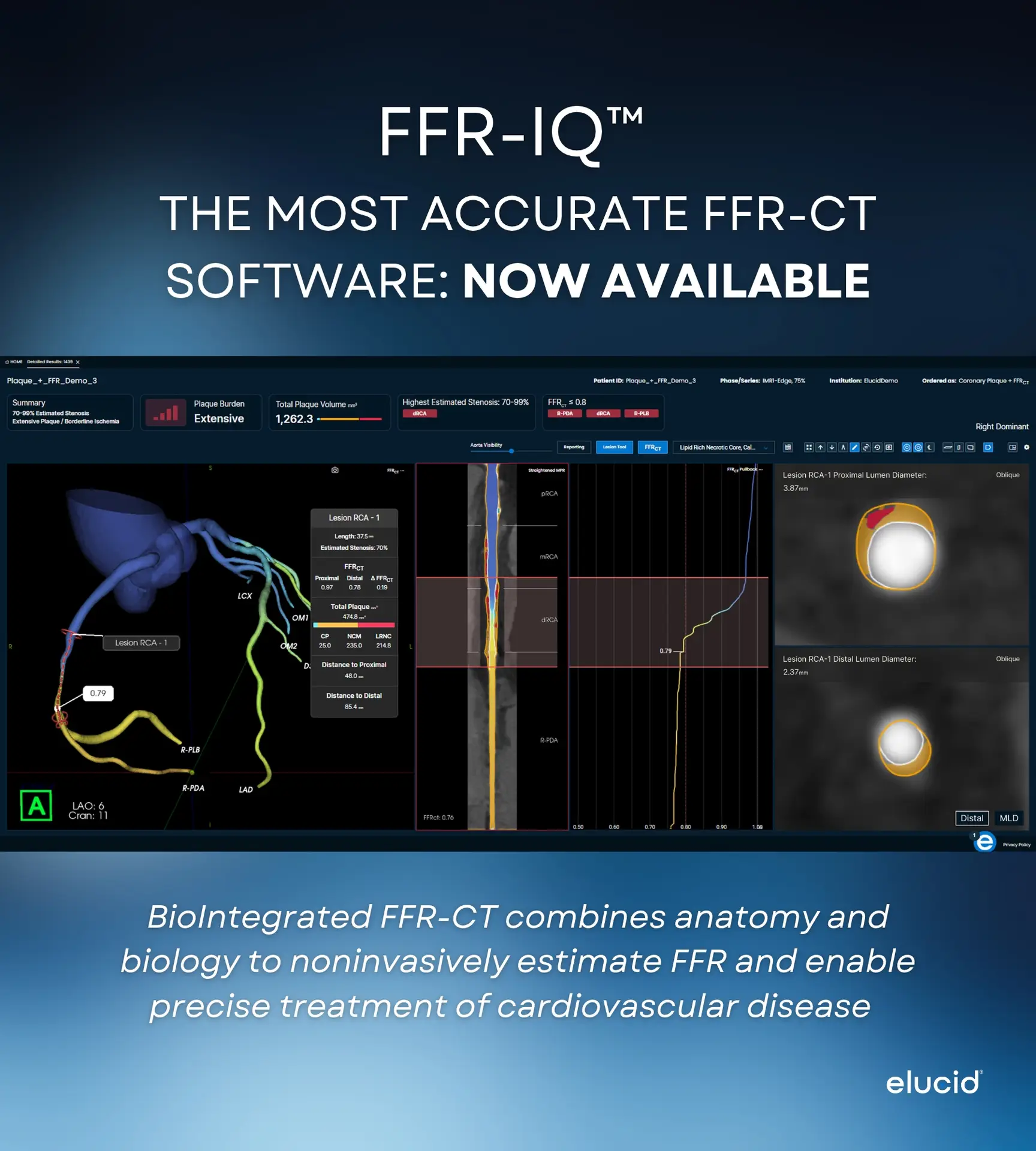
Elucid’s comprehensive clinical platform offers histology-validated plaque analysis including lipid-rich necrotic core, BioIntegrated FFR‑CT, and stenosis, plus a new user interface to be best in class for information to clinical insights.
Together, Elucid’s platform offers unmatched accuracy, reproducibility and transparency with key clinical insights to empower physicians to deliver lesion-level, personalized cardiovascular care.
The Myocardial Infarction Paradox
Patients deemed “low risk” still account for nearly half of all heart attacks. A recent study led by Mount Sinai researchers finds that following current screening guidelines may cause missed opportunities for early detection of heart attacks and prevention. Addressing this gap will require a paradigm shift from short-term, age-weighted risk prediction toward lifetime, disease-oriented prevention. Integrating imaging, biomarkers, and novel risk factors may help uncover subclinical disease earlier, when intervention yields the greatest benefit.4

What Physicians are Saying

See the Elucid Difference
Contact us today to learn more about Elucid or to schedule a product demo
References
1 World Health Organization (WHO), Cardiovascular diseases (CVDs). 2017 23, April 2020. Available from: https://www.who.int/en/news-room/fact-sheets/detail/cardiovascular-diseases-(cvds).
2 https://www.ahajournals.org/doi/10.1161/01.ATV.20.5.1262
3 https://pubmed.ncbi.nlm.nih.gov/39600843/
4 Mueller, A. S., Leipsic, J, et. al. Limitations of Risk- and Symptom-Based Screening in Predicting First Myocardial Infarction. JACC: Advances, vol 4, number 12,part 2, 1 December 2025. https://www.jacc.org/doi/10.1016/j.jacadv.2025.102361