
From Lesion-Level Risk to Patient-Level Impact.
Elucid is driving the evolution from population health-based treatment decisions to truly personalized, lesion-level cardiovascular care.

Plaque-IQTM
The only FDA-cleared plaque assessment tool powered by non-invasive CT Virtual Histology™
Elucid’s Plaque-IQ was trained and validated on ground-truth histology, the gold standard for plaque characterization, to deliver comprehensive patient, vessel, and lesion-level plaque composition and quantification data beyond Hounsfield Unit Thresholds. It is the only non-invasive plaque analysis indicated for use in the coronary and carotid arteries.
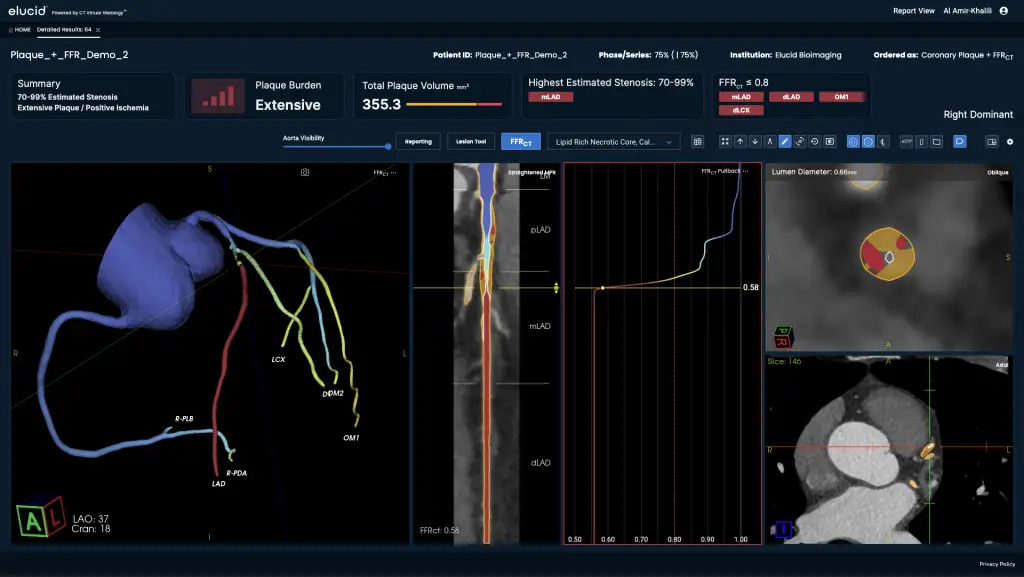
FFR‑IQTM
Remove the blindfold: Integrating plaque biology and plaque-based physiology for smart clinical decisions
Traditional computational approaches to CT-derived FFR model physiology primarily from anatomical geometry. Elucid’s BioIntegrated approach is based on a different premise: coronary arteries are living vessels, not rigid pipes.
FFR-IQ goes beyond the physical properties of the vessel and the lesion to include biological and morphological properties as well. The performance of the vessel during maximum hyperemia is dependent upon plaque composition, making highly accurate plaque and FFR‑CT both necessary for patient treatment decisions. Elucid’s is the first non-invasive FFR‑CT analysis solution to take this into consideration, offering concordance between plaque data and FFR‑CT data.
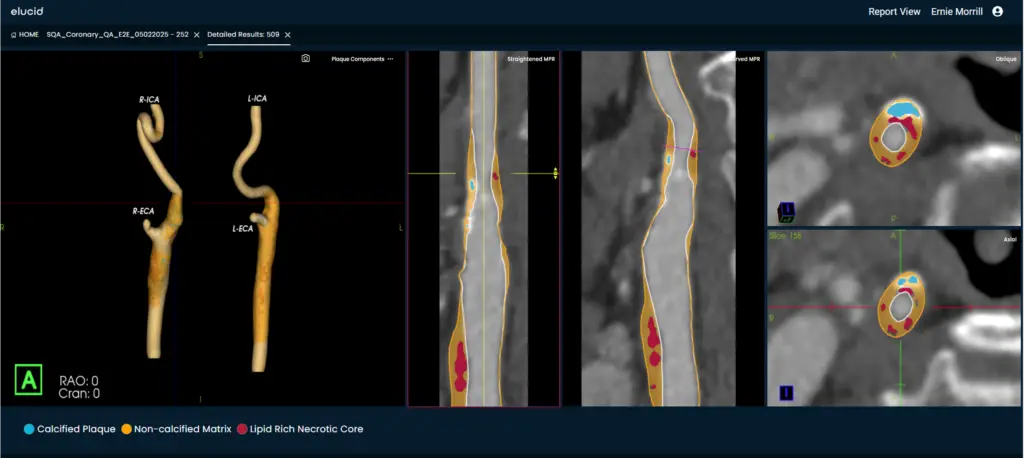
The first and only CT-based plaque analysis indicated for the carotid anatomy
Plaque-IQ is the first and only CT-based plaque analysis software indicated for both the coronary and carotid anatomies.
Carotid Plaque-IQ can help physicians identify carotid plaques at risk for rupture and develop patient-specific treatment pathways to prevent and monitor against ischemic stroke. When used for both the coronary and carotid arteries, Plaque-IQ non-invasively delivers a quantitative and qualitative assessment of systemic atherosclerotic risk and enables the ability to perform both coronary and carotid plaque analysis in a single scan.
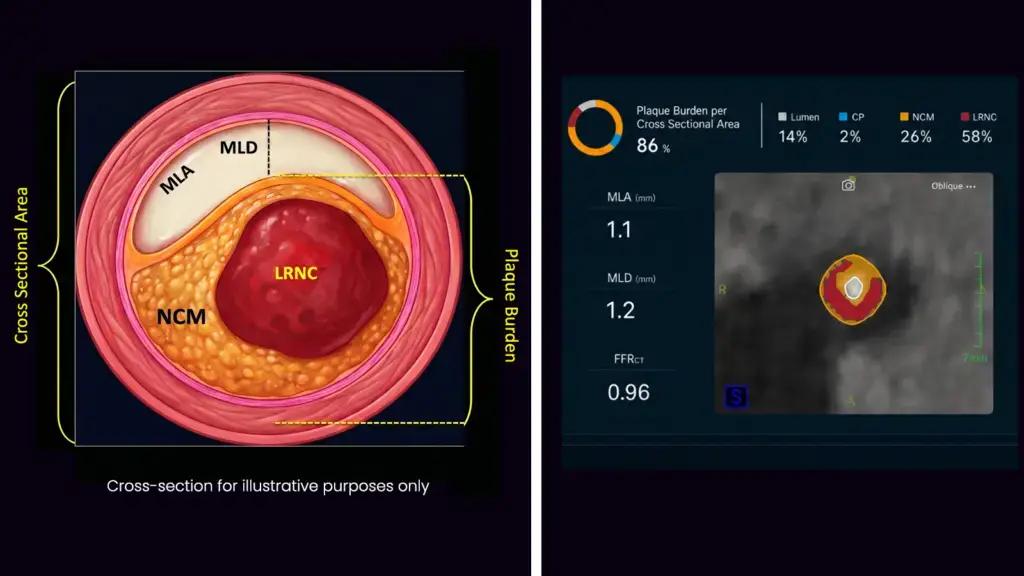
Quantify High-Risk Plaque
The Only Non-Invasive Assessment Tool Capable of Identifying LRNC
For both its coronary and carotid applications, Elucid’s Plaque-IQ is capable of identifying highly-vulnerable lipid-rich necrotic core (LRNC), a plaque type strongly linked with cardiovascular risk.²‚³ This offers direct insights into high-risk plaque features associated with heart attack and stroke, measuring true disease rather than directional proxies. By focusing on true disease biology rather than population-based risk estimates, this approach is designed to help physicians prioritize and personalize treatment for each individual patient.
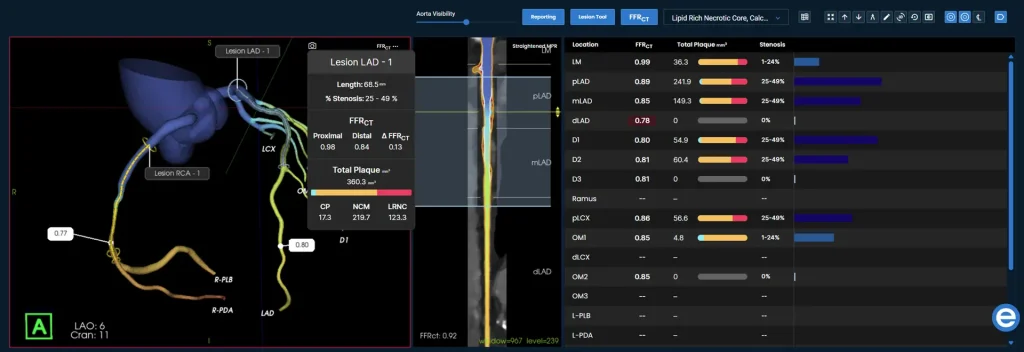
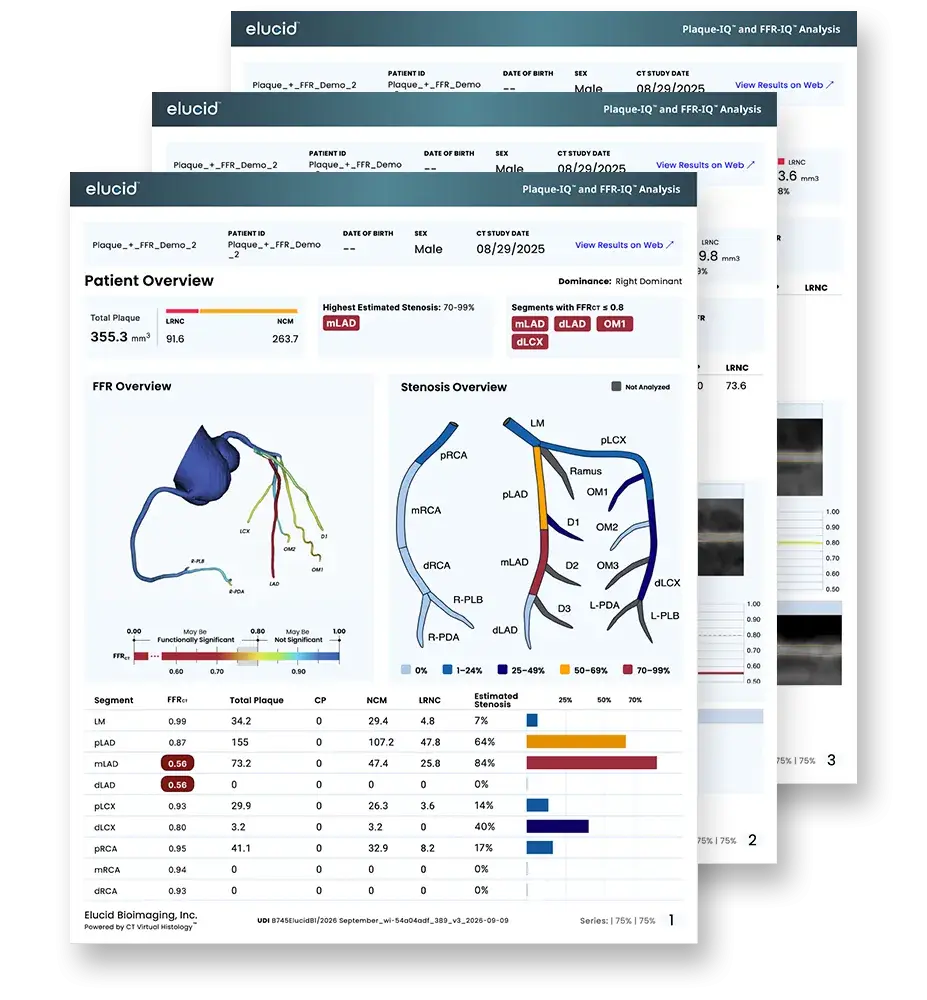
Complete Transparency through Accurate, Concordant Plaque-IQ and FFR-IQ
Two Data Outputs From One Source Make Concordance Possible
Results Delivered in Two Ways
Plaque-IQ delivers plaque quantification, luminal stenosis and stenosis evaluation to meet clinical workflow needs with a lesion-level view of coronary and carotid plaque, including LRNC. This detail helps inform patient-specific care decisions, including medical and cath lab decisions. Our transparent, segment-by-segment breakdown is automatically summarized in a clinical dashboard as well as a physician-validated PDF report.
Straightened Multi-Planar Reconstruction (MPR) – Visual confirmation of the entire vessel path for intuitive review of plaque distribution and stenosis severity
Transparent Segmentation – Automated metrics for every branch, from the Left Main to the distal segments, with color-coded plaque morphology mapping. Physicians can layer Plaque-IQ images over the raw CT to show vessel and wall segmentation, and the ability to view plaque by type. A fully-interpretable model allows physicians to see how FFR-IQ is derived from Plaque-IQ.
Stenosis Evaluation at a Glance – Instant summary cards for plaque burden, highest stenosis, and standardized scoring to help physicians make personalized clinical decisions
Reimbursement
Medicare and commercial coverage for Elucid’s Plaque-IQ provides broader access, enabling clinicians to get ahead of heart attack and stroke for a large, diverse patient population across the U.S. FFR-IQ is covered by all major insurance providers. The following resources are intended to help providers navigate billing and reimbursement for Elucid’s products.
CPT Codes
- Coronary CT Angiography (CCTA): CPT 75574
- Plaque-IQ: CPT 0623T-0626T- Jan 1-75577
- FFR-IQ: CPT 75580
Clinical Evidence

Elucid’s Plaque-IQ algorithms were validated on histopathologic specimens, including calculations of anatomic structure and calculations of tissue characteristics. The histopathologic validation demonstrated the following performance:
| Plaque Type | Elucid's Plaque-IQTM FDA Validation to Histology (r =) |
| Total Plaque | 0.99 |
| Calcified | 0.95 |
| Non-Calcified | 0.86 |
| Lipid Rich Necrotic Core (LRNC) | 0.88 |
*LRNC Area includes areas of LRNC and Intra-Plaque Hemorrhage as identified by pathologists **Data on file from K261855
Elucid values and encourages a collaborative approach to improve today’s clinical and economic outcomes and the future of personalized management for CAD. If you are interested in submitting a proposal for a research study, please contact us.
References
1 Ozkaya et al., JCCT 2026.
2 Bagherzadeh et al., JCCT 2026.
3 Bagherzadeh et al., JCCT 2026.
4 Aldana-Bitar, J, et al. Manuscript in press.
5 Kolossvary et al, JCCT 2026. Based on research version of FFR-CT, not the commercially-available version.